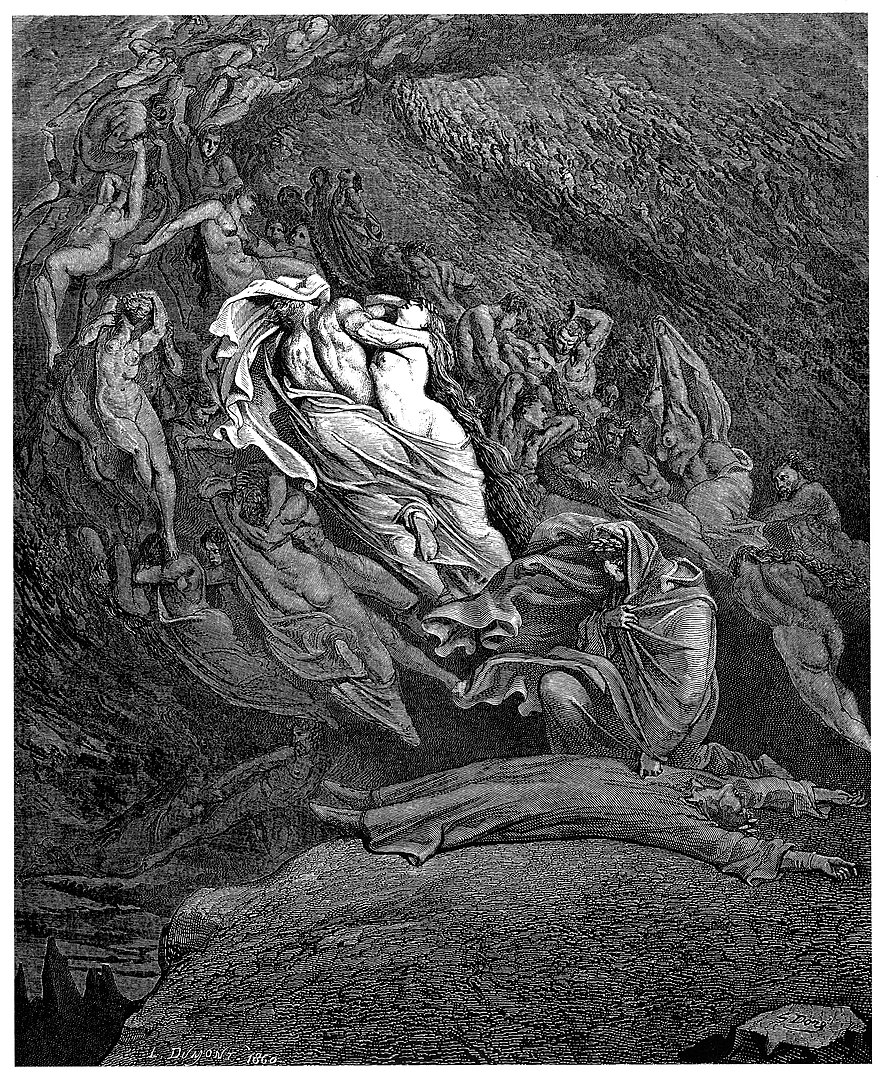
The Lust Layer or Second Circle of Hell marks the true beginning of the infernal abyss, where souls who subordinated reason to appetite are punished. It is the first circle of active torment, following Limbo, and is characterized by a dark, tempestuous, and deafening atmosphere. Here, the "carnal malefactors" are subjected to a violent, howling, and ceaseless storm, which represents the uncontrolled, chaotic nature of their desires while on Earth. As they allowed themselves to be swept away by passion, they are now eternally swept away by a tempest that gives them no rest.
The punishment in this circle is a direct example of Dante's contrapasso, where the punishment mirrors the sin. The lustful are not permitted to stop, signifying how they were driven by uncontrollable impulses in life. Dante describes the scene as a "howling darkness of helpless discomfort," where souls are battered back and forth in a "melancholy storm," mirroring the emotional turmoil of lustful passion. The environment is often described as cold, dark, and filled with the shrieks of the damned, contrasting sharply with the warm, often fleeting, pleasure of the sin itself.
Guarding this circle is the mythological figure Minos, who acts as the supreme judge of the underworld. Upon seeing each soul, Minos judges their sins and wraps his long tail around himself a certain number of times, indicating which circle of hell the soul is destined for. The Second Circle is the first to contain specific, named individuals, including famous figures such as Cleopatra, Helen of Troy, Achilles, and Paris. These souls, while technically in hell for their sins, are often viewed with a sense of tragic pity by the character Dante, reflecting the complex, often romanticized nature of their actions.
The most famous encounter in this circle is between Dante and the shades of Francesca da Rimini and Paolo Malatesta. Francesca tells their piteous tale, explaining how their love grew while reading a romantic story, and how her husband caught them and murdered them. This story, which highlights the tragic nature of their forbidden love, is so overwhelming to Dante that he faints out of emotional anguish. Despite the pity he feels, Dante, as the poet, clearly establishes that their actions—which broke social, familial, and religious bonds—are ultimately a form of "bestial" behavior that requires punishment, marking them as having sinned through "incontinence" or a lack of self-control.
Minos
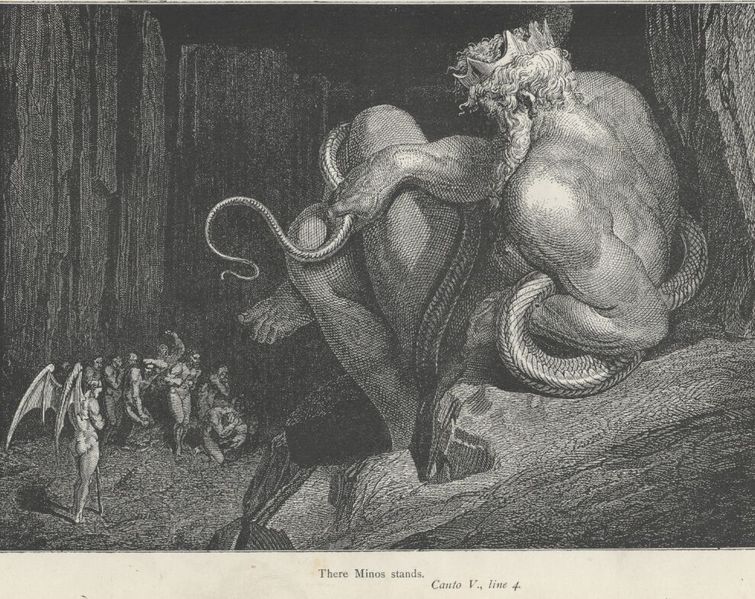
Minos is a prominent monstrous figure who serves as the infernal judge of the damned, situated at the entrance to the second circle of Hell. Derived from classical mythology, where he was a king of Crete known for his wisdom, Dante reimagines him as a demonic,, snarling beast who presides over the souls of the departed as they arrive in Hell. His primary role is to listen to the confession of each soul, "an expert judge of sins" who determines the appropriate level of punishment based on the severity of their transgressions.
Minos acts as a grotesque, administrative official of the afterlife, utilizing a unique, visceral method for assigning the damned to their eternal punishments. Upon hearing a soul’s confession, Minos wraps his long, serpent-like tail around his own body a specific number of times. The number of coils corresponds to the number of the circle of Hell to which the soul is condemned, signaling the "contrapasso" or the fitting punishment for their earthly crimes. This process highlights the orderly, albeit horrific, bureaucratic nature of Dante’s Hell.
Beyond his role as a judge, Minos represents the transition from the relatively harmless Limbo to the true, violent suffering of the lower circles. In Canto V, he confronts Dante and his guide, Virgil, warning them against entering the realm of the damned, which reinforces his role as a formidable gatekeeper. His presence is a blend of classical tradition—inspired by Virgil’s Aeneid—and medieval Christian doctrine, turning a mythological ruler into a demon that highlights the permanence of divine judgment.